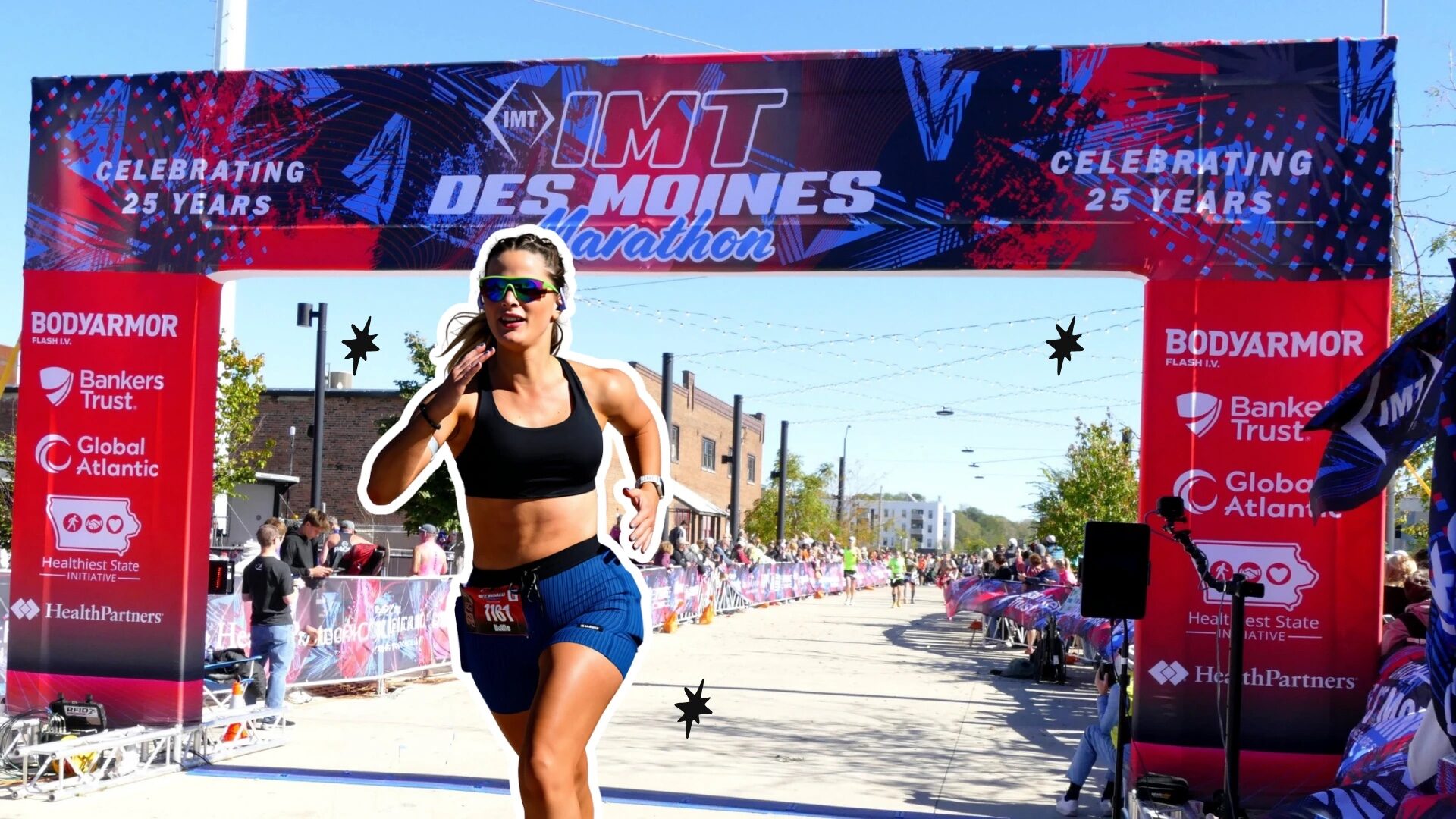
Fifteen months ago, I could barely run three miles without wanting to quit. On Sunday, October 18, I ran 26.2 miles in 3:58:14. In my first marathon. Somehow, I broke four hours.
I know a sub-four marathon might not sound particularly impressive to some runners, but for someone who started running in July 2025 with absolutely no distance-running background, it felt huge. A few questionable life choices, one very dramatic calf/Achilles scare, and a whole lot of miles later, I’m officially a marathoner.
So here’s my honest recap of the 2026 IMT Des Moines Marathon: how I trained, what race day actually felt like (including the part where I genuinely thought I might not finish), and what I’d do differently next time. Because despite telling my husband I would never do that again as I crossed the finish line, I entered the Chicago Marathon lottery the very next morning. Apparently, marathoners are not well.
How I Trained for My First Marathon
My first half marathon, in October 2025, was 2:04:50. My second, in April in Brooklyn, was 1:52:45 (here’s my Brooklyn Experience Half recap).
Then I spent 20 weeks, from June 1 to race day, following a Runna marathon plan. I had one very dramatic calf/Achilles situation in late September that had me holding my breath for the last three weeks, but I made it to the start line. Here’s what the whole block looked like by the numbers.
Weeks
20
Runs
73
Total miles
527.6
Time running
~88 hrs
Peak week
46.1 mi
Longest run
22 mi
My weekly mileage
- 30.11
- 18.02
- 8.83
- 32.94
- 19.55
- 30.66
- 13.67
- 33.38
- 31.09
- 28.710
- 14.511
- 30.112
- 34.813
- 6.514
- 24.415
- 43.916
- 46.117
- 27.418
- 18.519
- 34.820
Build week Lighter week Peak week Taper Race week
I know my weekly mileage doesn’t look like a beautiful, steady staircase. This was my first marathon training block, and I skipped a few runs here and there because, believe it or not, I do have a life outside of running.
Instead of climbing every week, my mileage came in waves: a few bigger weeks, then a lighter one to absorb them (weeks 3, 7, 11, and 14 were my lightest). My two biggest weeks, 43.9 and 46.1 miles, came back to back in mid-September, right before the taper. Month by month, I went from 89.9 miles in June to 132.2 in September.
The long-run ladder
My long runs built from 11 miles in week 1 to 14, 15, 16, 17, and 19 miles, mostly on these long run routes in Iowa City. My longest was a 22-miler on September 19, followed a week later by 20 miles at marathon effort. Race day was the first time I’d ever run farther than 22 miles.
The proof it was working
My easy-run heart rate dropped from about 155 bpm in June to 145 bpm in September, at a slightly faster pace (10:23 down to 10:16 per mile).
By late September, my Coros was predicting a 3:50:07 marathon. My goal was 3:49 to 3:55, which meant holding about 8:45 per mile. Spoiler: the course had opinions about that.
What I Wore for My First Marathon
Here’s everything I laid out the night before the race.

- Top: lululemon Jersey Training Long Sleeve Shirt (for the cold start)
- Sports bra: lululemon Energy Bra
- Shorts: Bandit Variegated Stripe Cadence 5” Compression Bottom
- Shoes: ASICS Megablast
- Socks: Bandit Quarter Sock
- Watch: Coros Pace 3
- Fuel: BPN Go Gels, Precision Fuel PF 30 gels and a PF 30 Chew, and an Amacx Drink Gel
- Extras: sunglasses, earbuds, and my bib
● Race-day music
Need something to listen to on race day? Check out my playlists.
Race Morning
My alarm went off at 4:45 (gross, but fine). I had a dry bagel with banana and honey at 5:00, the exact same breakfast I’d eaten before every long run all summer. We stayed downtown the night before, so there was no early drive, and my husband came with me to the start.
I was in Corral C and crossed the start line around 8:14 a.m. It was cold, and I was so nervous.


Waiting in the corral with my husband, and the view from Corral C.
Shuffling toward the start line.
My First Marathon, Mile by Mile
Miles 1–3: Settling in
And then I started crying. I don’t think I stopped until about mile 3. I’d put so much time and work into training for this marathon that I couldn’t believe I was actually there, surrounded by so many other runners. Something about marathons (even just the videos!) always makes me cry. (These emotional race day songs didn’t help.)
The crowds were big and the energy was high, and I was just trying not to do anything stupid in the first three miles. Success, mostly.

Miles 4–7: The hills (and a bathroom stop)
Here’s the thing nobody properly warned me about: the first half of this course is hilly. The official race guide lists 682 feet of climbing, and my watch recorded 1,043 feet.
The Grand Avenue hills in miles 5 to 7 were a shock to the system. They’re the kind of hills where you can’t see the top, and they feel like they never end. To top it off, I made the classic rookie mistake: I fought them, trying to hold goal pace uphill instead of letting my pace go and running by effort.
Also, at mile 6, I had to pee. It was quick, but it burned about a minute. Pour one out for that minute.
I broke down every hill (and how I’d pace them now) in my Des Moines Marathon course guide.
Miles 8–13: The comeback… and the dark patch
Once I got through the worst of the hills, the course settled down and I clawed time back. I ran miles 7 to 11 between 8:43 and 8:51 per mile, including a lap of the track at Drake Stadium, and hit the halfway mark in 1:58:03, right on track.
And then, at mile 11, I fell apart mentally.
I was struggling and tired at mile 11. It was the worst I had ever felt at mile 11 in my entire training cycle, through every 20-miler and every long run. I started freaking out and genuinely doubting whether I would finish. Every marathon story tells you the dark patch comes at mile 20. Mine showed up at mile 11, and because it was so early, it scared me. The math in my head was brutal: if I feel like this now, how do I have 15 miles left?
Miles 14–17: The second wind
I just kept running, one mile at a time. Around mile 15, there’s a big downhill, and somewhere on it I caught a second wind. (I was saying prayers of gratitude for that mini break.) The doubt didn’t disappear exactly, but it shut up, and I hit mile 17.4 still averaging under 9:00 per mile.
Around mile 15, I also met two girls in matching outfits who were trying to go sub-4 too. They seriously saved my race. I made it my goal to stay with them, and I genuinely don’t know if I would’ve made it without them. The running community is amazing!
Miles 18–23: Flat, flat, flat
The second half of this course is extremely flat, like a completely different race from the first half. I slowed down or stopped for about five seconds at a lot of the aid stations to actually get water in, which cost a little time but kept me fueled. Somewhere in here, my right leg started cramping a little (oddly enough, not the leg that gave me trouble during training). Probably a sodium thing? It wasn’t bad, and I ran through it.
The only downside of this stretch is that the crowd support dies off once the course heads onto the trails. My sweet husband and his friend rode bikes around the park to catch me twice during this section, which was so key.
It was a real test of mental strength, especially when I caught a glimpse of runners at mile 22 across the cones while I was still finishing mile 19. I’m truly proud of myself for not stopping here. I just focused on keeping my momentum, because I knew sub-4 was within reach. It helped that one of my favorite transitions came on around mile 18 and gave me a little boost right when I needed it.
Miles 24–26.2: The last climb and the finish
There’s one more climb at mile 24, and by then I was spending everything I had left. My pace hovered around 9:00 to 9:06 for the last few miles, and then I somehow found a kick: my watch had me at 8:25 pace for the final stretch, and I started passing people I’d been trailing for miles. I turned onto the finish straight and crossed the line in 3:58:14, a few minutes off my goal, and honestly? Thrilled.
I sobbed crossing the finish line. (Again, marathons make me so emotional.) It was the hardest physical thing I’ve ever done in my entire life, and I told my husband I never wanted to do that again. Guess how long that lasted? (Not even 24 hours.)


Coming back downtown and the finish kick.
The finish line sprint and getting my medal.
My Des Moines Marathon Splits
- 18:51
- 28:54
- 38:53
- 48:53
- 58:56
- 69:51
- 78:43
- 88:48
- 98:47
- 108:51
- 118:48
- 129:05
- 139:08
- 149:13
- 158:58
- 169:17
- 179:00
- 189:13
- 199:01
- 209:11
- 219:02
- 229:07
- 239:02
- 249:06
- 259:03
- 268:56
- 0.448:25
Bathroom stop Second wind (downhill) Finish kick (pace)
See my official chip times
● Chip times
OFFICIAL CHECKPOINTS
| Checkpoint | Time of day | Time | Avg pace |
|---|---|---|---|
| 0.9 mi | 8:24 a.m. | 10:18 | 11:26/mi |
| 4.3 mi | 8:52 a.m. | 38:21 | 8:55/mi |
| 5.8 mi | 9:07 a.m. | 54:10 | 9:20/mi |
| 10.3 mi | 9:46 a.m. | 1:32:41 | 8:59/mi |
| Half | 10:11 a.m. | 1:58:03 | 9:00/mi |
| 17.4 mi | 10:50 a.m. | 2:36:33 | 8:59/mi |
| 23.6 mi | 11:47 a.m. | 3:33:53 | 9:03/mi |
| Finish | 12:11 p.m. | 3:58:14 | 9:05/mi |
My official time was 3:58:14 for 26.2 miles (9:05 per mile). My watch measured 26.44 miles because I weaved around a lot of people, so my watch splits run a little faster than my true pace. I still like them for the mile-by-mile story, since the timing mats aren’t always exactly where they’re labeled.
Fueling: The Plan That Actually Worked
Fueling was the thing I was most nervous about, and it went well. My plan was a gel about every 30 minutes, alternating a BPN Go Gel and a Precision Fuel gel, for about 54 grams of carbs per hour, and I took every gel with water at an aid station. I saved the caffeinated gels for the second half (about 150 mg of caffeine total).
Seven gels, zero stomach issues. If you’re a first-timer reading this: practice your exact race fueling on your long runs. All of them. It’s not optional homework, it’s the whole game. Here’s my ranking of 10 running gels and chews and my favorite Trader Joe’s snacks for carb loading.
What Running a Marathon Actually Feels Like
Okay, I knew a marathon would be insanely hard, but it was even harder than I thought, even after all the training. Race effort is a completely different beast from long-run effort, and on race day it got hard way earlier than it ever did in training. But I already want to do another one, because I learned so much and have so much I can improve on next time.
It’s also not one long, steady struggle. It comes in waves. I went from “I’m not going to finish” at mile 11 to feeling great at mile 15 to grinding at mile 24, and then the finish line made all of it disappear. Race-day adrenaline, a goal, and a strong “why” can push you further than you could ever go on a regular training day.
7 First Marathon Tips I Learned the Hard Way
- Run hills by effort, not ego. If I had let myself slow to 9:15 on the early hills instead of fighting them, it would have “cost” me about a minute and probably saved me several in the second half. My race plan literally said this. Race-day adrenaline made me forget.
- The dark patch might come early. Mine came at mile 11, not mile 20. Know that it can happen, and know that it passes.
- Practice your fueling on every long run. Seven gels, zero stomach issues, because I’d done it all summer.
- Stop for five seconds to drink. Slowing down at aid stations to actually get water in was worth every second, and I’d do it again every time.
- Set a hard cutoff for fluids on race morning. I was sipping water out of anxiety, and that mile-6 bathroom stop cost me a full minute.
- Take your salt. My cramping in the last 10K was probably a sodium thing. Powerade sounded so gross to me the whole race, but I should have been taking both water and Powerade at every aid station.
- Trust your training. I had every kind of taper anxiety: phantom injuries, race pace feeling impossible, easy runs feeling weird. It really does all work out in the end.
After the Finish
My husband and friends were waiting for me after the finish, but first I had to use my best girl grip to carry everything out of the finishers area: water, BodyArmor, energy drinks, pizza, pickle juice, cookies, and of course, my medal! My legs locked up almost immediately, and it was a long, slow, painful walk to the car (so worth it).


With my husband and my favorite cheer squad.
What’s Next
A real recovery week (or two), a winter of strength training and shorter speed work, and a spring half marathon where I’m chasing the 1:40s. And maybe marathon number two in fall 2027?
If you’re training for your first marathon: you can absolutely do this. Just maybe respect the hills more than I did. Running Des Moines? Start with my course guide, and send your cheer squad my spectator guide. Shopping for a marathoner? Here’s my gift guide for runners.

● New: spectator planner
Add your goal time and your cheer squad will know exactly when you’ll pass each spot.
● The Des Moines Marathon series
- 01 Course guide: Is the Des Moines Marathon hilly?
- 02 My race: My first marathon recap (3:58:14) You’re here
- 03 Spectating: Where to watch the Des Moines Marathon
First Marathon FAQ
How long does it take to train for a first marathon?
Most first marathon plans are 16 to 20 weeks long. I followed a 20-week Runna plan, peaking at 46 miles a week with a longest run of 22 miles.
What does running a marathon feel like?
Harder than long runs, and it comes in waves. I felt awful at mile 11, caught a second wind at mile 15, and ground out the last few miles. The finish makes it all worth it.
How many gels do you need for a marathon?
It depends on your pace and the gels. I took seven gels, about one every 30 minutes, for around 54 grams of carbs per hour, and had no stomach issues.
Is the Des Moines Marathon a good first marathon?
Yes. It’s well organized with great crowds, but the first half is hilly, so run the early hills by effort, not pace.