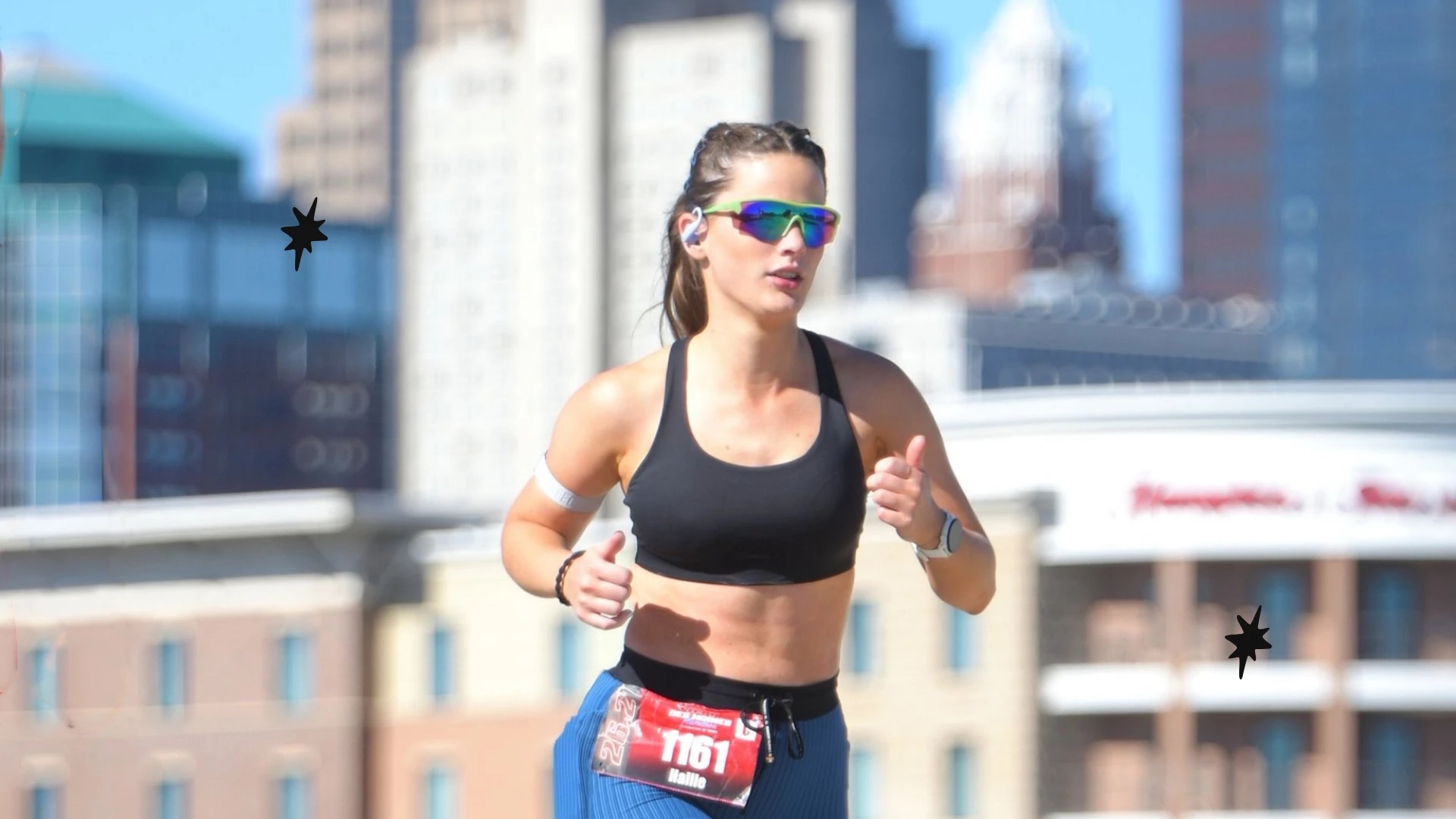
If you’re signed up for (or thinking about) the IMT Des Moines Marathon, you probably have the same questions I did: How hilly is the course? Where are the aid stations? Is it scenic? What are the crowds like?
I ran it on Sunday, October 18, 2026, as my first marathon and finished in 3:58:14 (here’s my full first marathon recap). My biggest takeaway? The course is a lot hillier than I expected. It’s by no means mountainous, and you can absolutely PR here, but I wish I’d mentally prepared for the hills and planned my pacing better.
The good news: it’s still a great course, and I’d strongly recommend this race. Going in mentally prepared will make the biggest difference on race day, so here’s the honest, mile-by-mile guide I wish I’d had: where the hills actually are, how to pace them, what the aid stations and crowds are like, and who this course is (and isn’t) for.
● The short answer
Yes, but only the first half. Almost all of the climbing happens between miles 4 and 14, with the biggest hills on Grand Avenue around miles 5 to 7. After a big downhill at mile 15, miles 16 to 23 are some of the flattest marathon miles you’ll ever run.
Des Moines Marathon Course Map and Elevation
This is the official course file I loaded onto my watch. Drag along the elevation chart to see exactly where the climbs are, and tap the blue dots for aid stations. You can also download the GPX to load onto your own watch. (On a Coros? Here’s how to turn it into a mile-by-mile race plan.)
● Interactive course map
IMT Des Moines Marathon course
- 26.2 mi
- Hills: miles 4–14
- Flat: miles 16–23
- Start mi 0
Downtown Des Moines - Pappajohn Sculpture Park mi 4.15
Big downtown crowds before the hills - Grand Avenue hills mi 4.8
The main climb starts here - Des Moines Art Center mi 6.58
Near the top of the Grand Avenue climb - Drake University mi 10.62
A lap of the track in Drake Stadium - The big downhill mi 14.8
About 140 feet down in one mile - Valley Junction mi 16.12
Historic Valley Junction in West Des Moines - Water Works Park mi 21.66
Flat, pretty, and exposed if it’s windy - Gray’s Lake mi 23.8
Still flat, almost home - The last climb mi 24.2
Short, but it shows up at mile 24 - Finish mi 26.2
Downtown Des Moines - Aid stations
Small blue dots on the map
Des Moines Marathon Elevation: How Hilly Is It, Really?
According to the official race guide, the IMT Des Moines Marathon has 682 feet of elevation gain and 682 feet of loss. For a little context, here’s how that compares to two of the most famous marathons:
● Elevation compared
HOW HILLY IS DES MOINES?
| Marathon | Gain | Loss | Known for |
|---|---|---|---|
| Chicago | 243 ft | 238 ft | About as flat as it gets |
| Des Moines (official) | 682 ft | 682 ft | Somewhere in the middle |
| Boston | 815 ft | 1,275 ft | Rolling hills |
| Des Moines (my watch) | 1,043 ft | 1,020 ft | Felt hillier than advertised |
But I have questions about those official numbers. My Coros Pace 3 recorded 1,043 feet of gain and 1,020 feet of loss on race day. GPS watches aren’t known for perfect elevation accuracy and often overestimate, so take my data with a grain of salt. Still, that’s a big difference, and I don’t think the official stats quite capture what this course feels like to run.
Either way, the hills caught me off guard, and it’s not like I skipped hill training. I’d been running weeks with well over 1,000 feet of climbing. I just believed Des Moines was the fast, flat course it’s often advertised as and expected a few gentle rollers at most. I’d trained for the distance, but I hadn’t mentally prepared for how hilly the course would feel.
We can debate the exact numbers all day, but they matter a lot less than where the climbing is:
- It’s front-loaded. About 75% of the climbing happens in the first 14 miles, while your legs are still fresh. That’s great in theory, unless you burn too much energy holding pace on the hills and pay for it later (hi, it’s me).
- There’s one long climb, and the rest are rollers. The big one is Grand Avenue around miles 5 to 7.
- The second half is extremely flat. After a big drop around mile 15, the course barely changes elevation until mile 24. I was very grateful for this during the out-and-back in Water Works Park.
- There’s one last climb at mile 24. It’s short, but it shows up at exactly the wrong moment.
The Des Moines Marathon Course, Mile by Mile
Miles 1–4: Downtown and settling in
The race starts downtown near Two Rivers Park, and the first few miles are gentle: a little rolling, tons of crowd energy, and marathoners and half marathoners running together. You cross the Des Moines River a couple of times and pass Pappajohn Sculpture Park around mile 4. Nothing scary yet. This is the calm before Grand Avenue.

Miles 5–7: Grand Avenue Hills
This is where the marathon splits from the half, and it’s also where the real climbing starts. Grand Avenue is the hill section of the Des Moines Marathon: about 200 feet of sustained climbing past the Des Moines Art Center to the high point of the course around mile 7. Attack it, and it will absolutely wreck your race plan.
My watch had me at 8:56 for mile 5 and 9:51 for mile 6 (about a minute of that was an emergency bathroom stop). I held close to my goal pace up these hills, and that was my biggest mistake of the race. I still finished under 4 hours, but I gave away a lot of my buffer by attacking these hills harder than I should have.
● How to run it
By effort, not by pace. Let your pace slide 20 to 30 seconds per mile on the climbs without a second thought. Every second you “save” fighting these hills gets charged back to you (with interest) after mile 20.
Miles 7–14: Rolling through Drake
The hills don’t end at mile 7. They just get a lot less dramatic. This stretch rolls along the high ground through the neighborhoods and around Drake University, including a lap of the track inside Drake Stadium around mile 10 (very cool!). Right after Drake, there’s a dip and another climb around mile 11.
I ran miles 7 to 11 between 8:43 and 8:51 per mile and hit the halfway point in 1:58:03, right on track. Shout-out to all the locals cheering from their lawns and handing out water cups and Nerds Gummy Clusters! The crowd support was surprisingly great for a neighborhood stretch.
But because I’d attacked the hills, I started to feel tired around mile 11, and then I started to mentally spiral. I recovered, but learn from my mistake so you don’t spend as long in the pain cave as I did.
Miles 14–16: The big downhill and Valley Junction
Around mile 14.5, the course drops about 140 feet in a mile. It’s a gift. I caught my second wind on this downhill after a rough mental stretch.
At the bottom, you run through Historic Valley Junction in West Des Moines, which has a fun, small-town main street feel. After the quieter neighborhood miles, the crowds pick back up here, and lots of runners were spotting their family and friends.
Miles 17–20: The Bill Riley Trail (the quiet miles)
From Valley Junction, the course loops onto the Bill Riley Trail until you reach Water Works Park. These are the most isolated miles of the race, and the crowds thin out, but they went by surprisingly fast. This is also where the course flattens out for good.
● Race-day music
These are the quietest miles of the race, so bring something to listen to. Here are my songs for the last 6 miles, or check out my playlists.
Miles 20–23: Water Works Park and Gray’s Lake (pancake country)
You get miles of genuinely flat running through Water Works Park and around Gray’s Lake. It’s pretty, it’s exposed in places if the wind is up (it was), and it’s where patient runners can make up time.
Around mile 20, cones split the path into an out-and-back. The runners on the other side are already heading toward mile 22, and you can see more runners across the park. Personally, this was the mentally toughest part of the race. Everything hurt, and I was dying to be one of the runners on the other side of the cones.
Luckily, this stretch was surprisingly well supported for a trail, and seeing a couple of friends here gave me a huge boost. I ran miles 18 to 23 at about 9:00 to 9:13 per mile and slowed down at the aid stations to actually drink.
Mile 24: The last climb
One more climb. It’s short and nowhere near the biggest hill on the course, but at mile 24 it doesn’t have to be. If your goal pace has zero seconds of slack, this hill will find them. I ran mile 24 in 9:06, and my perceived effort was way off: I thought I was speeding up a lot more than I actually was.
Miles 25–26.2: Back downtown to the finish
The last stretch takes you back over the river and into downtown for the finish. It’s flat, loud, and over before you know it. (Mostly. The last mile of a marathon is never fast enough.)


Coming back into downtown and the final stretch.
How to Pace the Des Moines Marathon
From someone who learned the hard way:
- Miles 1–7: run by effort. Your pace will be slower than goal on the Grand Avenue hills. Let it. Easing off on a couple of hilly miles costs you maybe a minute. Fighting them costs a lot more later.
- Miles 7–14: stay patient. It keeps rolling. Settle in at goal effort and don’t start chasing time yet.
- Miles 15–23: take what the course gives you. Use the downhill and the flat miles to get into a rhythm, but keep your effort even. This is where races are lost by people who feel great at mile 20.
- Mile 24: expect the climb. Know it’s coming, shorten your stride, get over it, then race home.
Aid Stations and Course Extras
There are aid stations about every 2 miles, all with water and Powerade, and they’re marked as blue dots on the map above. My strategy was small sips at every station and every gel with water. In 2026, there were also a few fun extras:
- Mile 17.4: Coca-Cola
- Mile 21.4: pickle juice
- Mile 23: bacon (because Iowa)
Extras can change year to year, so check the race website before race day. For gels, here’s my ranking of 10 running gels and chews.
Des Moines Marathon Weather
Mid-October in Iowa usually means a cold start and a mild finish. In 2026, it was about 43°F at the 8 a.m. start (feeling more like 36°F) and about 57°F by noon, with sunny skies and wind picking up to 10 mph or more with gusts over 20 mph by the end.
Bring a throwaway layer for the corral and dress for the finish temperature, not the start. Here’s what I wear running in 35 to 45 degrees, and why October is my favorite month for running in the Midwest.
Race-Day Logistics: Start Time, Corrals, and Parking
The marathon starts at 8:00 a.m. downtown, and the corrals go off about 3 minutes apart. I was in Corral C.
● Race morning cheat sheet
- Start time: 8:00 a.m. (2026)
- Corrals: start about 3 minutes apart
- Porta potties: none inside the corrals, but plenty with short lines just outside
- Parking: only tricky near the start and finish, so aim to arrive before 7:00 a.m.
Since there aren’t any porta potties inside the corrals, use the ones just outside before you line up. There are plenty, and the lines are short. (My mile 6 bathroom stop was not part of the plan.)
Driving and parking are really only a hassle right around the start and finish downtown, where the streets close. Give yourself plenty of time and try to get there before 7:00 a.m. so you’re not stressing about making it to your corral.
Who Is the Des Moines Marathon For?
Great fit: first-timers who want a well-organized, mid-size, very Iowan marathon and are willing to respect the first half. Patient racers. Anyone who runs better in cool fall weather.
Think twice: if you’re chasing a PR and you’re not a patient early pacer. The front-loaded hills will test you, but a smart first half sets you up for one of the flattest final 10Ks around.
Bringing a cheer squad? Send them my Des Moines Marathon spectator guide with 7 spots to cheer and driving directions.

● New: spectator planner
Add your goal time and your cheer squad will know exactly when you’ll pass each spot.
My Verdict
The IMT Des Moines Marathon is not a flat course. It’s a hilly first half glued to a flat second half: two different races in one. Run the first half like it matters (it does), and the second half will take care of you.
I ran 3:58:14 in my first ever marathon here! Here’s my full first marathon recap if you want the whole story.

● The Des Moines Marathon series
- 01 Course guide: Is the Des Moines Marathon hilly? You’re here
- 02 My race: My first marathon recap (3:58:14)
- 03 Spectating: Where to watch the Des Moines Marathon
Des Moines Marathon Course FAQ
Is the IMT Des Moines Marathon hilly?
Yes, but mostly in the first half. Most of the climbing is between miles 4 and 14, with the biggest hills on Grand Avenue around miles 5 to 7. Miles 16 to 23 are very flat, with one short climb at mile 24.
How much elevation gain does the Des Moines Marathon have?
The official race guide lists 682 feet of elevation gain and 682 feet of loss. My Coros watch recorded 1,043 feet of gain in 2026. Watches often overcount, but either way, nearly all of the climbing comes in the first half.
Where are the hills on the Des Moines Marathon course?
The main climb is on Grand Avenue around miles 5 to 7, followed by rolling hills through Drake University until about mile 14. There’s one more short climb around mile 24.
When is the Des Moines Marathon?
The IMT Des Moines Marathon is held in mid-October. In 2026, it was on Sunday, October 18.
Is the Des Moines Marathon a Boston qualifier?
Yes. The IMT Des Moines Marathon is a Boston Marathon qualifier, so your finish time counts toward a BQ.
Is the Des Moines Marathon good for a first marathon?
Yes! It’s well organized, mid-size, and has great crowd support. Just plan to run the first-half hills by effort, not pace.