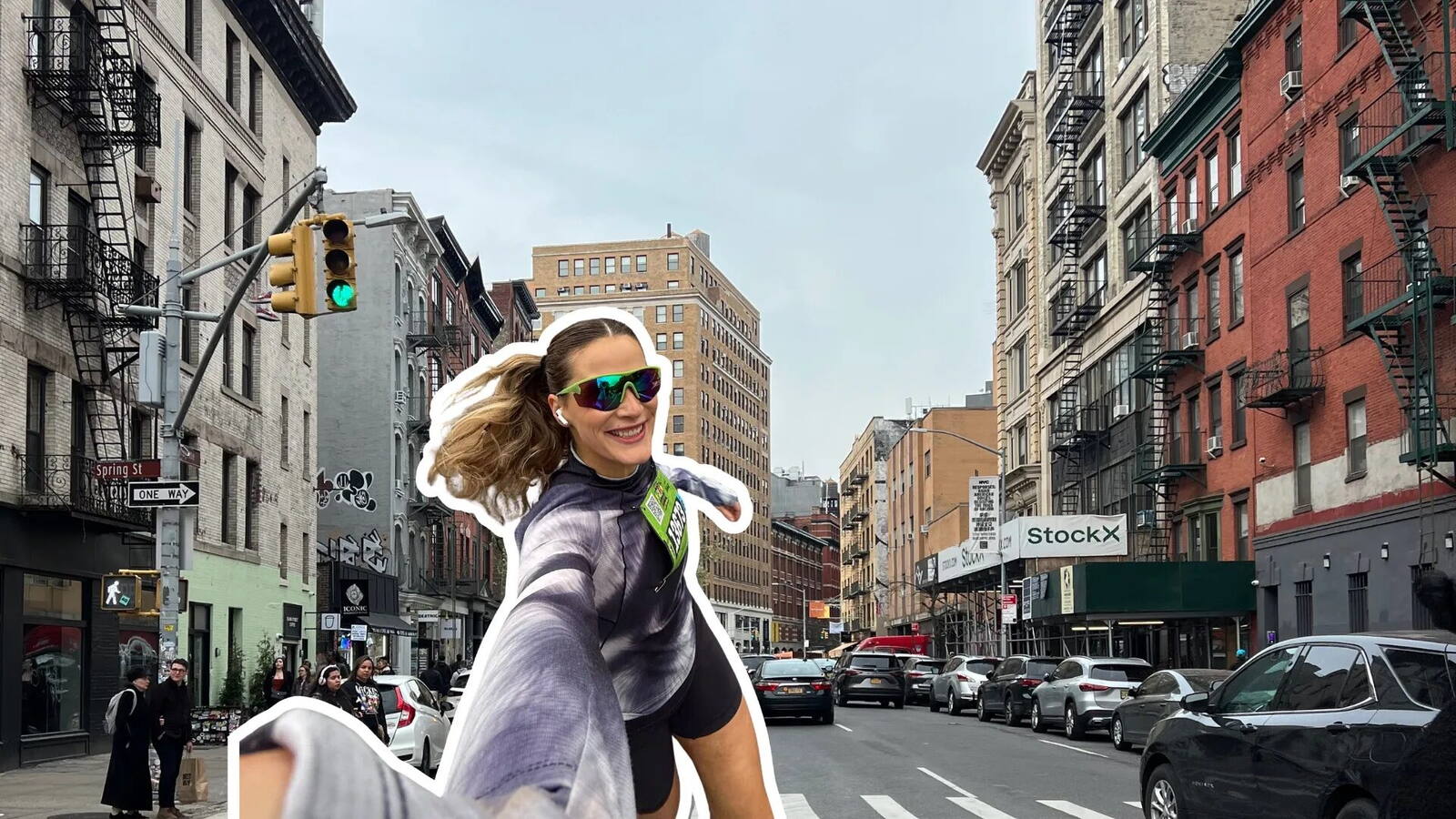
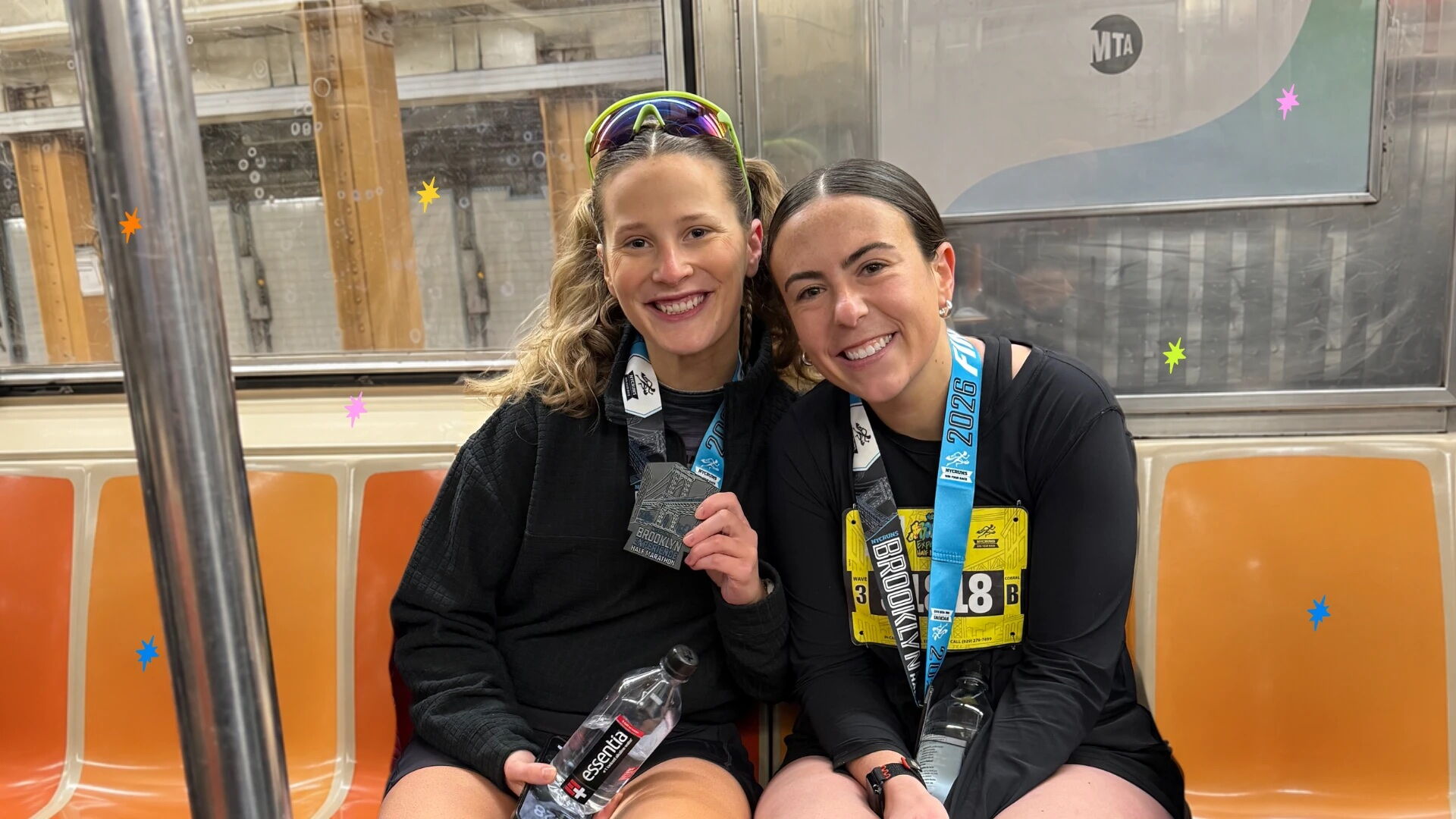
Last April, I lined up at the NYCRUNS Brooklyn Experience Half Marathon just hoping to break 2 hours. I finished in 1:52:45. My first half marathon was 2:04:50, so I took more than 12 minutes off my time in one training block. One of the best parts about being a new-ish runner is that you tend to get faster really quickly in your first couple of years. It was so fun to see what some actual focused training would do to my time, and it was seriously such a fun race!!
Below is my whole training plan week by week, the workouts that helped the most, and the one stat that told me it was actually working.
● The short answer
I trained for 13 weeks and ran about three to four times a week, usually with one harder workout. I stayed around 10 miles a week through the worst of winter, built up to 27.6 miles in March, and my longest run was 10 miles. On race day I ran 1:52:45, more than 12 minutes faster than my first half.
My Half Marathon Training by the Numbers
Weeks
13
Runs
41
Total miles
198.7
Peak week
27.6 mi
Longest run
10 mi
Time running
~32 hrs
Workouts
13
Time saved
12:05
I started training less than four months after my first half marathon in October 2025, and my winter running was pretty sad. I averaged about 7 miles a week and ran only 25 miles in all of December (thanks, holidays and bad weather). I still had some endurance left over from my first half, but I’d never really done speed work, and I knew I needed to run a lot more.
I picked Brooklyn because I really wanted to run a race in NYC, and it’s a lot easier to get into than some of the NYRR (New York Road Runners) races. I was really proud of my first half marathon, but finishing it left me wanting more. For that one, I didn’t follow a training plan or do much besides building up to a 10-mile run. I’m really grateful I signed up for another half before my first marathon, because this block gave me the foundation I needed before I started marathon training.
My Half Marathon Goals
Honestly, I just wanted to break 2 hours. My first half was less than 5 minutes over that, so I felt pretty good about my chances if I built up my endurance and got a little faster. I trained with Runna (a running app that builds your plan for you), and it predicted I’d run a 1:52. I had no idea I’d hit it right on the nose until I checked my official race results, and I was so stoked.
My Half Marathon Training Plan, Week by Week
Here’s the shape of my 13-week training block, from January 25 to race day. The first month was a little shaky in terms of following my training plan because of horrible Midwest weather (snow, wind, and -30° windchills), but after that I followed my Runna plan pretty closely.
- 10.11
- 3.82
- 10.73
- 1.14
- 11.05
- 10.86
- 27.67
- 17.68
- 22.79
- 25.610
- 22.011
- 18.912
- 3.813
- 13.3Race
Winter base Peak week Taper Race day
Looking back, my training fell into three pretty different stretches.
Winter (weeks 1 to 6). This part was pretty thin, and honestly it’s what I’d change. I was running around 10 miles a week, with two weeks where I barely ran at all because it was cold, dark, and the trails were covered in snow. So when March hit, my mileage almost tripled in one week, from 10.8 to 27.6 miles. It worked out because I’d already been running that much in the fall, but if you’re a beginner, I don’t recommend jumping up this fast. You probably shouldn’t follow my lead here.
Building up (weeks 7 to 12). This is where I actually got fitter. I ran at least 17 miles every week for six weeks straight, and showing up week after week mattered way more than any one big week. Some weeks even had two workouts instead of one. I actually learned to love my Runna workouts. They were just the right amount of challenging and made really good use of my time.
The taper (week 13). The taper is the last stretch before a race when you cut way back, so I cut almost everything. Race week was one short 3.8-mile fartlek (a run where you throw in fast bursts whenever you feel like it). One nice thing about traveling for a race is that you don’t have as much time to panic and get restless. I spent the days before hanging out with family and friends and enjoying the city.
What a typical week looked like
My goal was four runs a week, but I ended up averaging three thanks to winter. Every run had a job, though.
- One workout. Over-and-unders, a tempo run, hills, or short, fast repeats (I explain each one below). A few weeks in March and April had two.
- One or two easy runs. Truly easy, which turned out to matter more than anything (more on that below).
- One long run. Building to 10 miles, often on hills, since the Brooklyn Experience Half is hillier than most people expect.
About 70% of my miles were easy, and that’s even counting warm-ups and cooldowns as workout miles. Keeping my easy days actually easy is what let me squeeze two hard workouts into some weeks and still feel ready for the next one.
The Workouts That Got Me a PR
I did 13 workouts in this block. Instead of listing every single one, here’s how fast each type of workout was compared to the pace I ran on race day.
- Easy runs9:43–10:24
- 10-mile long run10:12 → 8:25
- Over-unders8:41 / 8:02
- Tempo7:47–7:56
- 800s7:40–7:55
- K200s7:45, 6:40 surge
- Hill reps6:26–8:00 uphill
Pace per mile from my Coros, for the hard part of each workout. Over-unders are from my March 31 session. Hill paces are short uphill bursts, so they aren’t comparable to flat pace.
Almost every workout was faster than my race pace (8:37 per mile), and my easy runs were more than a minute slower. That sounds backwards, but the hard days make race pace feel easier, and the easy days leave you enough energy to actually nail the hard ones.
Over-and-unders (3 times)
In an over-and-under, you switch back and forth between a pace that’s a little harder than “comfortably hard” and one that’s a little easier, without stopping. It teaches you to settle back down while you’re still working, which is basically what the second half of a half marathon feels like. My first few were clunky because I wasn’t used to hitting specific paces, and I was checking my watch about every 10 seconds. By the end of March I was switching between about 8:40 and 8:05 per mile. That meant my “easy” part was basically race pace, which was a pretty good sign I could hold it for 13.1 miles. I still wasn’t totally confident in my goal pace, but I didn’t feel far off, either.
Tempo runs (3 times)
Man, I’m not going to lie, tempo runs are my least favorite. A tempo run is a steady, comfortably hard effort for a set distance. Mine were 2 to 2.5 miles at about 7:50 per mile, which is around 45 seconds faster than my race pace. That gap is kind of the point. If you can hold 7:50 for 2.5 miles, 8:37 for 13.1 starts to feel a lot more doable. These were also the workouts that had me doubting my goal, because every single one left me gasping for air (which, technically, is also the point).
Hill repeats and alternating hill reps
The Brooklyn course has one long climb and a few rolling hills, adding up to just under 500 feet of elevation gain, so hills were a big part of my plan. I did 60-second hill repeats in February and a mix of 60- and 30-second hill sprints in late March. Hill repeats are basically sneaky speed work, and honestly they’re my favorite. You work just as hard as you would on a track, but the hill naturally shortens your stride, so they’re easier on your legs than sprinting on flat ground. I have a hill right by my apartment that’s about a 6% incline, which is perfect for 30- to 90-second intervals. I end a lot of my runs on it, so I get some extra climbing in every week, but sprinting up it is still one of the hardest workouts I’ve ever done.
Speed work with 800s and K200s
These were the fastest things I ran all block. An 800 is 800 meters, about half a mile (or two laps around a track). I ran five with a short rest in between, and they kept getting faster, from 7:55 pace down to 7:40. That told me I probably started out a little too careful.
K200s are a kilometer (about 0.6 miles) at a hard pace with a 200-meter sprint tacked onto the end, three times through. That sprint is the useful part, because it teaches you to speed up when you’re already tired. That’s exactly what the last mile of a race asks for, and I’d like to think it’s where my 8:11 final mile came from.


Workout notes written on my hand (low-tech, but it works) and a gel in the middle of a long run.
The long runs that mattered
My longest run was 10 miles. Instead of going longer, I made my long runs harder, with hills, a fast finish, and a full race-day dress rehearsal.
- April 4, 10-mile hilly progressive. My longest run of the block. A progressive run just means you get faster as you go, so I started around 10:10 per mile and ran my last mile at 8:25, with over 400 feet of climbing along the way. My watch rated it the hardest run of the whole block. Honestly, it was more of a mental battle than anything since it was a cold, windy Saturday morning, but I felt surprisingly good after.
- April 18, 6.5-mile race-practice long run. My dress rehearsal averaged 9:26 per mile (3 miles at race pace and 3.5 easy). I used the same breakfast and fuel I planned to have on race day, which was toast with honey and bananas, and wore my Bandit set with a long sleeve because it was still pretty dang cold here in Iowa! Practicing my gels on long runs is also how I learned that caffeine and half marathon pace don’t gel well with my stomach, but that’s all part of the process. (Here’s my ranking of 10 running gels and chews if you’re still finding yours.)
My fastest training run was a 2.5-mile tempo about three weeks before race day, and I actually PR’d my 5K (25:50) during it. Accidental PRs are the best (can you tell I run a lot of 5Ks? lol).
● Workout music
Speed work goes a lot faster with a good playlist. Check out mine.
How My Easy-Run Heart Rate Showed It Was Working
My favorite stat from this whole block isn’t a pace. It’s my heart rate on easy runs. Here are two easy runs, ten weeks apart, at almost the same pace.
10:24 → 10:16
165 → 146 bpm
134 → 87
Average heart rate in beats per minute, from my Coros. Lower is better at the same pace.
In April my heart rate was 19 beats per minute lower, even though I was running a little faster. In other words, my body didn’t have to work nearly as hard to run the same pace, which is one of the clearest signs you’re getting fitter. You won’t notice it from one day to the next, but it’s a big part of why race pace felt doable on race day. I first noticed it on a small hill on one of my regular routes. It used to make me breathe a little heavier, but near the end of the block I could run right up it without my breathing changing much.
Training Through an Iowa Winter
Training for a spring half marathon in the Midwest means most of your miles happen in January, February, and March, a.k.a. some of the worst months for running in the Midwest.
The hardest run of my whole block happened in the snow, too. Right after I got over a short respiratory illness, my plan gave me a 5K time trial (basically running a 5K as hard as you can on your own). I ended up hacking up a lung and keeled over in the snow on the trail… yikes. Here’s what helped me get through the rest of winter.


Snow-covered trails in March and a windy, very cold April long run.
- Layer up, but not too much. I dress like it’s 15 to 20 degrees warmer than it is. If you’re a little chilly when you start, you’re probably doing it right.
- Get your muscles going before you head out. I like to do 5 to 10 minutes of resistance band exercises before going out into the cold. It warms up my muscles and makes the cold slightly more bearable.
- Move your runs around the weather. Honestly, most of being consistent is just checking the forecast and planning ahead. I’d usually plan my long run for the warmest part of the day on Saturday and save easy runs for the treadmill on really cold days.
- Use the treadmill when it’s unsafe. My whole first week was on the treadmill. It’s terrible, but I learned it’s a lot better if you slow down even more than usual and just run by feel. There’s absolutely no point in torturing yourself. Put on a good movie or a podcast, or if you’re like me, watch DJ sets from Boiler Room like this one.
- Warm up your room before you get out of bed. I keep the remote for my space heater on my nightstand and turn it on about 15 minutes before I get up, which makes early morning runs a lot easier to start.
- Have something to look forward to when you get home. Whether that’s a warm drink or a hot shower, it helps a lot with motivation.


February vs. the first warm day of spring.
Race Week
My bib and shirt showed up a few weeks before the race. Shout out to the Brooklyn Experience Half for having really cute race shirts (I actually still wear this one!).

On race day, it all came together. I ran the first half in 56:41 and the second in 56:04, so I actually got a little faster as I went (runners call that a negative split). The long climb up Flatbush Avenue still slowed me down, and mile 8 was my slowest at 8:55, but I bounced right back to 8:20 and 8:21 in Prospect Park. Getting back on pace after a hill is exactly what all those hill repeats and over-and-unders were for (and a RuPaul-into-Britney transition on my playlist helped at mile 11, too). For fuel, I took three GU Tri-Berry gels, one every 30 minutes. I walk through the whole race, mile by mile, in my Brooklyn Experience Half course review.
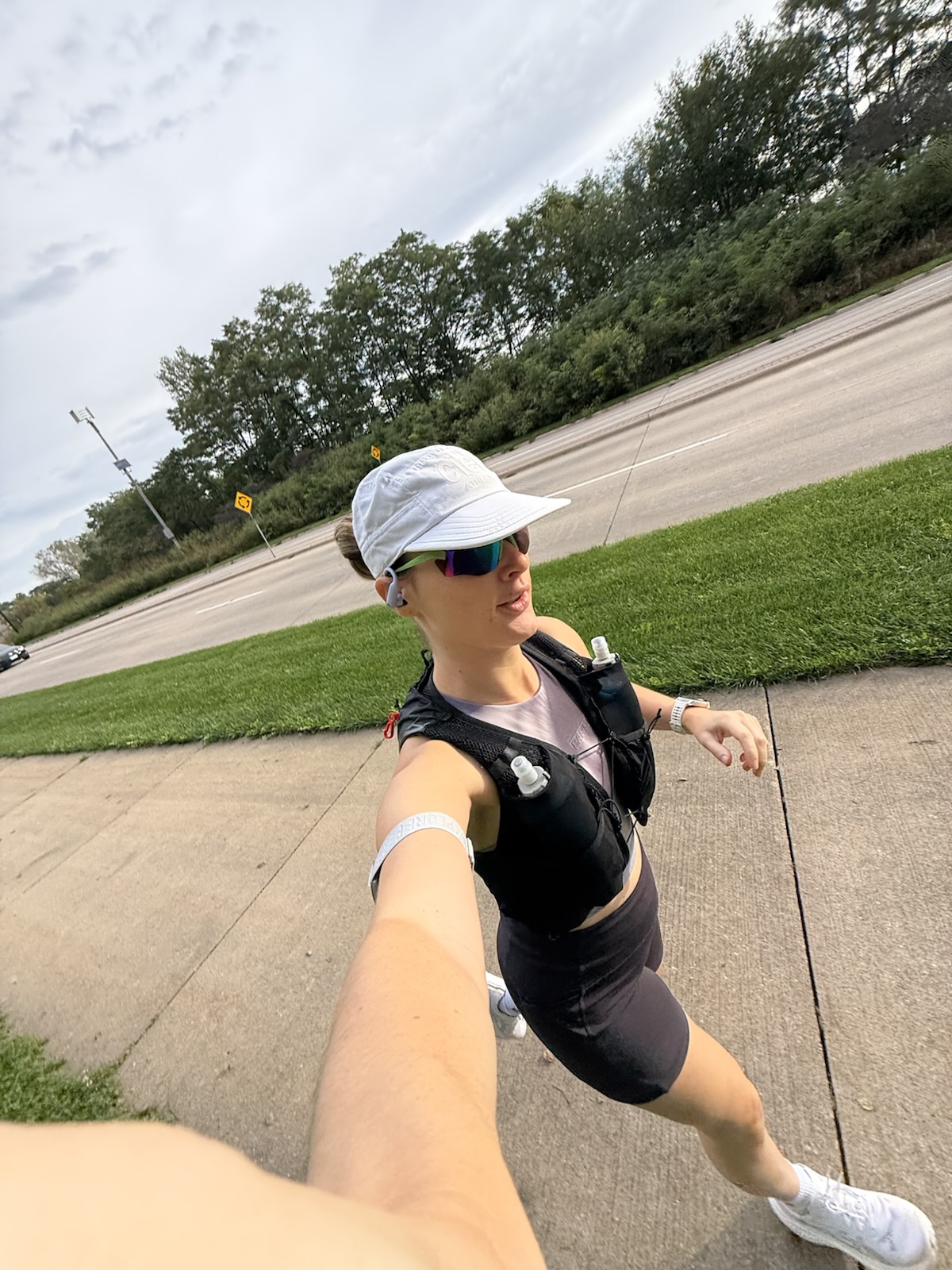
My Training Block in Photos


What I’d Do Differently
- Add more strength training. I mostly skipped it. It’s super hard to find the time, but it’s well worth it!
- Be more consistent in winter. Now that I’m more experienced, I plan to get better about logging treadmill miles when the weather sucks this winter. It’s just part of living somewhere cold.
- Build mileage more gradually. That jump from 10.8 to 27.6 miles in one week is the one thing I wouldn’t repeat.
Half Marathon Training Tips for Beginners
- Keep most of your runs easy. If you can’t hold a conversation, lose the pride and slow down. Your future runner self will thank you!
- You don’t need huge mileage. My biggest week was 27.6 miles and my longest run was 10 miles, and I still ran a 12-minute PR.
- Pick one workout a week. One quality day is plenty most weeks. I did 13 workouts in 13 weeks.
- Practice race day. Test your shoes, outfit, breakfast, and fuel on long runs first.
- Respect the taper. You won’t lose fitness in the last week. You’ll just show up fresh.
● The Brooklyn Experience Half series
- 01 Training: How I trained for a 12-minute half marathon PR You’re here
- 02 The race: Brooklyn Experience Half course review and photos
- 03 Spectating: Where to watch and cheer at the Brooklyn Experience Half
Half Marathon Training FAQ
How many miles a week should I run for a half marathon?
It depends on your experience. Many beginner plans peak around 20 to 25 miles a week, while intermediate plans often reach 30 to 40. My peak week was 27.6 miles, and I still took 12 minutes off my PR.
Can a beginner train for a half marathon?
Yes. If you can run about 3 miles comfortably, a beginner half marathon training plan of about 12 weeks can get you to the finish line.
How do you know if your half marathon training is working?
Watch your easy-run heart rate. In February, an easy run at 10:24 per mile had my heart rate at 165 bpm. By April I was running 10:16 per mile at 146 bpm, which is a sign of better aerobic fitness.